
If price goes higher, it creates bullish FVGs. If price goes lower, it creates bearish FVGs. This is a fact that consistently happens in the market.
Thus, FVGs tell us a direction.
But there are times when FVGs can be used as manipulation, so don’t let it fake you out. Here’s how to spot those manipulation FVGs in 3 steps.
What is Manipulation?
Manipulation is speed, fast price action.
People associate speed with certainty: “Fast price moves → we must continue in that direction.”
It’s in our human nature to think so.
So when price is trying to manipulate people into the market, what will it do?
It will create fast, one-sided price action.
Your Bias
Especially if the target is clear; for example, the HTF is clearly bullish.
Then, to manipulate price, we might see aggressive bearish moves at first, tricking people into the wrong positions.
You have a bias for a reason. Stick to it, don’t get impulsive, and don’t constantly switch from bullish to bearish. Because then the FVGs are playing games with you.
Manipulation FVG
Fast, 1 sided price action (manipulation) sooner or later leads to creating an FVG.
This is usually shown with large FVGs.
The larger the FVG, the less likely it is to simply have a sting into it and hold.
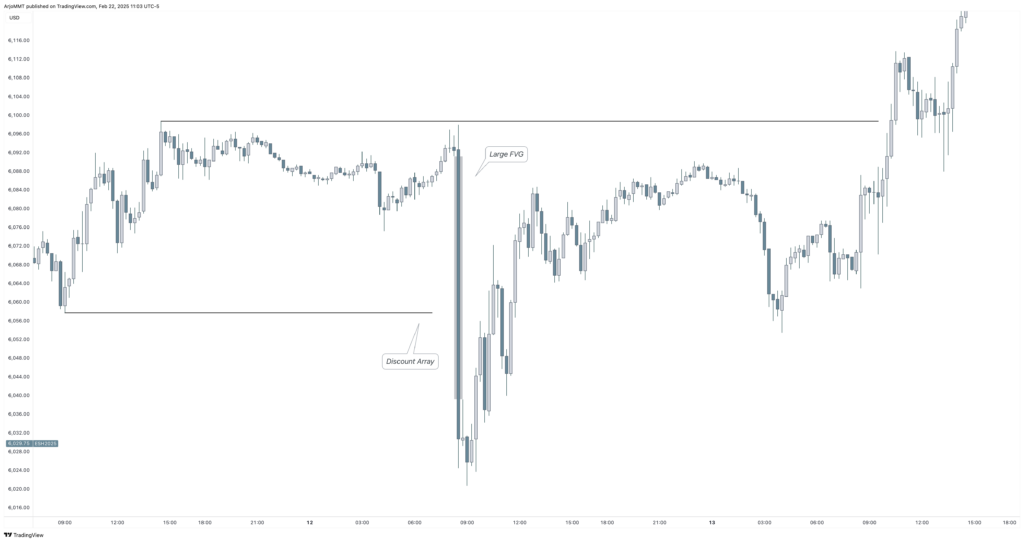
Many people’s first reaction is to follow the large FVG, but don’t get blinded by it.
For every FVG, you might have made an assumption in your head already if it will hold or not, you might suspect it being a manipulation FVG.
But for every FVG, it’s always better to assume it might hold at first, even if you don’t want to trade it.
Because this allows us to understand when the FVG is getting disrespected, taking away any argument that the FVG might still hold.
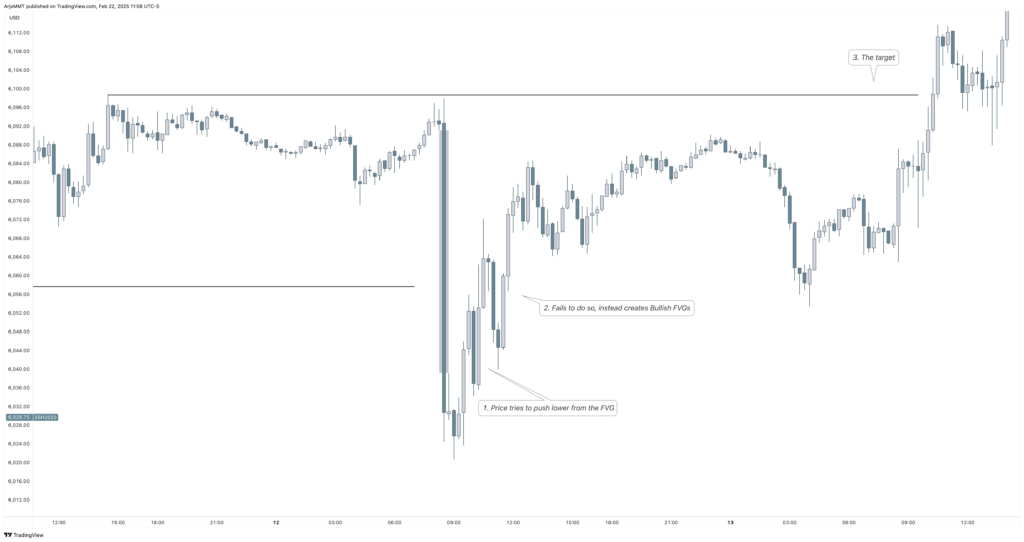
Now, see how this in itself could be a trading plan.
We can use Resistance as our Narrative.
And, of course, details like this and, more importantly, how to implement them are widely discussed in the MMT.
Arjo Janssens — MMT