
Is Day Trading Gambling or a Skill-Based Profession
November 3, 2025
While people are making money from day trading, many are also experiencing losses. Is day trading gambling if only a few people can profit from it? Can you use actual skills to profit from the rapid price movements of any market? This guide answers both questions in detail and other subjects involving risk management.
Disclaimer: This is for education only, not financial advice. Trading involves risks where you can lose money!
Key Takeaways
- Day trading is a skill-based profession if traders base their decisions on research and careful analysis.
- Gambling involves participants being expected to lose, although some may make money on their bets.
- Day trading can be considered gambling if a trader uses emotion to dictate their decisions.
Is Day Trading Gambling?
While day trading seems similar to casino games, it is not gambling. Competent traders or people with a basic understanding of the markets make money from their trades. The question of “is day trading gambling” comes from the perception that anyone who blindly buys and sell assets can still make money. To get a complete answer, we go through what day trading is about and the concept of gambling.
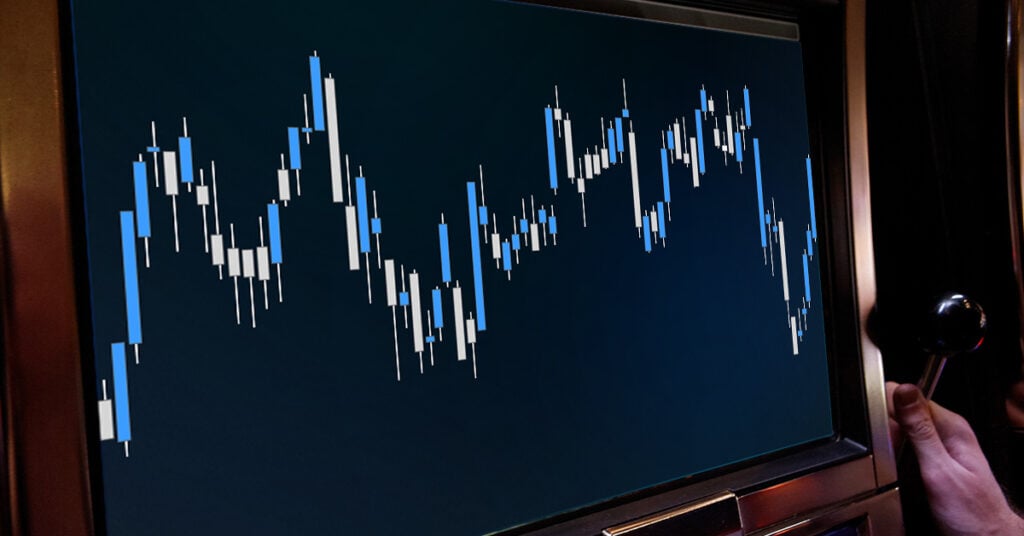
Day Trading Basics
To summarize what is day trading for beginners, it is the act of buying and selling assets that can be converted into cash easily. The term “day” comes from trading these assets within the same day by taking advantage of rapid short-term price movements.
Traders can make gains by taking positions while the market moves in their favor. If you were to take a long position (buying an asset or share), you make money when the market experiences an uptrend. Note that you can even make money if the market experiences a downtrend by entering a short position. This involves borrowing an asset and selling it back at a lower price.
To break it down, you are speculating on which direction the market is moving to make money. This makes day trading a speculative market.
Expected Returns in Day Trading
Going back to the example of a person making blind trades and experiencing a profit. How is this different or the same as betting on red while playing roulette? Traders are taking positions for an expected return on investment. This statement is how to confidently answer “Is day trading gambling?” with a complete “no.”
Expected returns come from the Modern Portfolio Theory (MPT), where investors ensure there is a return on their stake or positions. Those expectations come from thorough research of an asset and historical price movement.
A good example of expected returns through research is consulting the latest highs and lows of the Asian and London Sessions. When researching the price movements before the North American session opens, traders are better equipped to make gains with their trades.
Traders are still expecting a risk on their position for the price to move against them. This is normal, especially when participating in a highly volatile market.
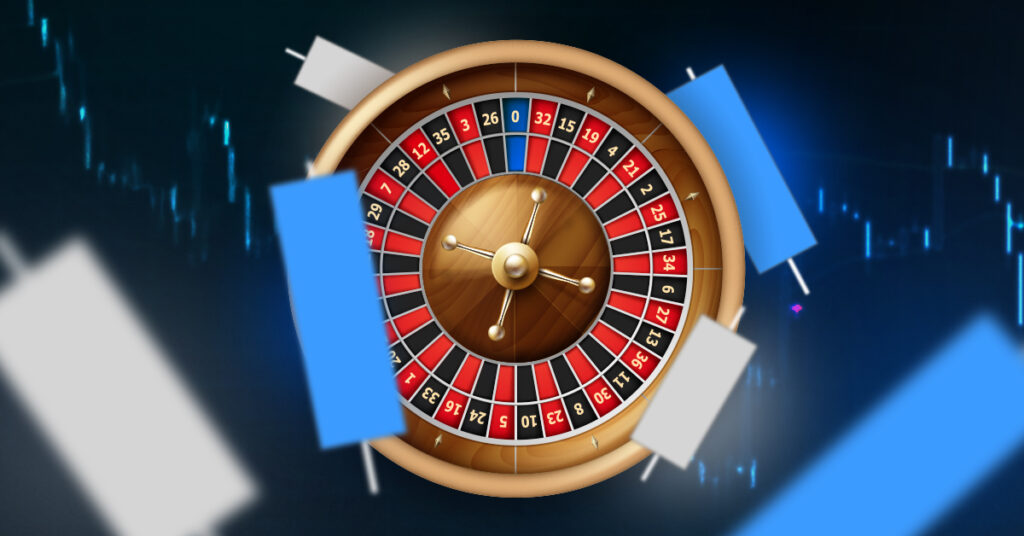
Game of Chance Difference
The house edge is how day trading is different from a game of chance. In casinos, each game has a house edge against the player that is measured by the return to player (RTP) percentage. The higher the RTP, the lower the house edge is for a game. If a slot game has an RTP of 99%, the house gets 1% of the total bet made on that game, while the rest goes back to the players.
With that concept alone, there is already an expectation that players will lose their wagers while the casino is guaranteed to profit. Why are there winners, or how are there players who gain twice or a hundred times their bet? Those gains come from other players who did not win their bet. A game’s winning is equally distributed based on the RTP, while the casino takes a cut in each spin.
Casino players are expected to lose money with each bet. This includes games that seem to have a 50/50 chance of winning, like roulette. In reality, the probability of winning either red or black is 48.65% due to the presence of a 0 slot. Your likelihood of winning is much lower if you are playing on a roulette table with a 0 and 00 slots.
Another important aspect of day trading to understand is that not all markets act like casino games. Games like roulette, slots, and even blackjack rely on random results. Even if you are blindly entering positions, your probability of making money from your trade can be much higher than 50%.
On the other hand, price movements can be predicted (and in some cases, even influenced). A predictable result is that day trading is a skill-based profession and does not rely on luck.
Overview of Day Trading vs Game of Chance
Is day trading gambling given the risk? It is not the same as making bets on any game of chance. Below are the key points of the difference between day trading and gambling:
- Day traders have expected returns based on their market analysis.
- While there are risks of losing money from positions, there are risk mitigations to lessen losses.
- Gambling is where players are “expected” to lose in order for the house to keep running.
- A game of chance requires randomness to prevent being predictable, while market price movements can be predicted.
- There are no 50/50 games within casinos, while day trading gives you more than 50% chances of making money.
Keep in mind that blindly buying or selling assets is no different from gambling. Have the proper mindset of profiting from your trades by joining our MMT Beginners membership. For 1 EUR, you have a lifetime access to various resources that will grant you the skills needed to make smart trades.
How Day Trading is Gambling
Day trading becomes a profitable skill when effort is made to understand the market. Is day trading gambling when people rely on luck as they randomly take positions and do not know what they are buying or selling? This section discusses the parallelism of day trading and casino games.
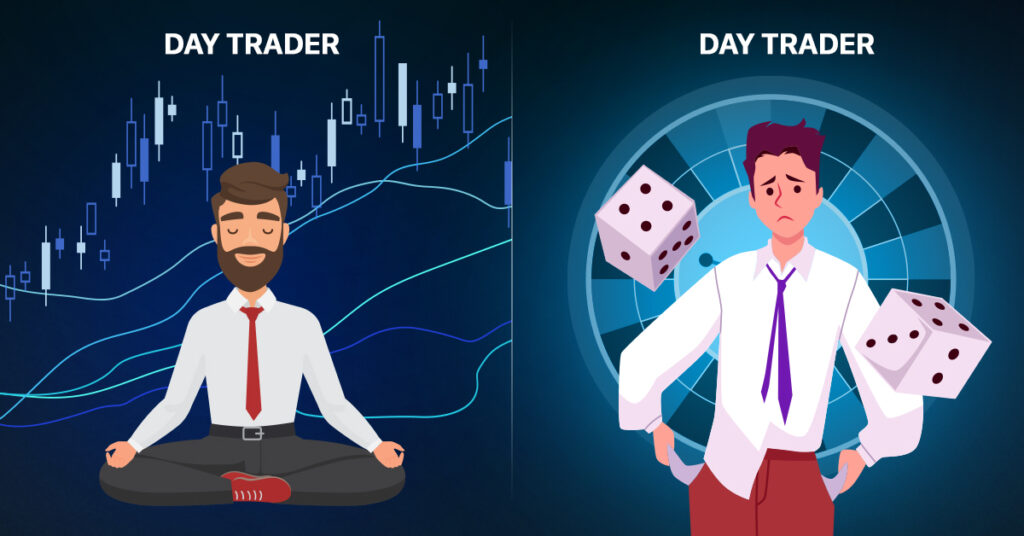
Dopamine Release
One of the ways casinos hook a player is to give visual and auditory rewards. When a slot machine triggers a large payout, it gives players a unique winning animation and cheerful music. Those sights and sounds allow for a dopamine release that makes a player feel happy and excited.
How can a slot be the same as day trading? There are no audio or visual rewards when the market moves in your favor. Unfortunately, trading platforms do have them.
Below are the sources of dopamine for a day trader:
- A series of large bullish candlesticks after taking a long position.
- Notification sound alerts when the market reaches a specific price level.
- The green percentage of your position’s gains as it climbs while the market is moving.
No one can deny the thrill of seeing your prices move the way you predicted they would. Unfortunately, that thrill or dopamine often leads to greediness. Traders would not exit their positions to see more gains, only to see the price move in the opposite direction, and hoping for a correction.
Fear of Missing Out
There is also the fear of missing out (FOMO) with traders believing they are exiting their positions too early. For these traders, they dread that their $150 profit could have been $500 or even $1000. FOMO is the same mindset gamblers have when chasing their losses by staking more money than they can afford.
The same can happen with day traders. These are often the ones who have lowered their risk tolerance by accepting more losses just to achieve an incredibly high payout. By ignoring the risk, they allow their losses to eat away at their capital. This leads them to missing out on potential gains.
Traders who let their emotions influence their decisions could also be risking money they cannot afford. One example is a Knoxville trader who took out a 60K loan and doubled it through day trading. Rather than cashing out, he kept on trading it until he ended with 100K of debt.
Another example of FOMO is when people just blindly enter a position because of hype. his scenario occurred in 2021 when social media and internet forums encouraged people to buy GameStop stock. This led to new day traders without any prior knowledge of the market buying shares when prices were at their peak. Their losses come from buying into the hype of a stock without considering the risks or that GameStop shares will experience a reversal.
Final Words: Day Trading is Still Not Gambling
Is day trading gambling or skill-based? If you placed a significant effort in reading candlestick patterns and researching an asset, day trading is not gambling. However, traders can also be subject to a gambling mentality if they allow their emotions to make their decisions or do not do their research. Gain the mindset of a profitable trader by joining MMT beginner today for just 1 EUR!
FAQ: Day Trading as a Skill-Based Profession
What does “risk of ruin” mean in trading?
A risk of ruin is the probability of losing your capital, leaving you with limited trading capabilities. Those limitations can force some people from making new trades even though they still have capital in their accounts. Traders consistently making riskier moves tend to experience a risk of ruin.
Should I trade around major news or earnings?
Trading the news or participating in day trading during important events can be risky due to the high volatility of the market. Smart traders have a strategy or rules when entering and exiting their positions during trading hours after significant news breaks out.
What is the expected percentage of my return as a skill-based day trader?
There is no standard percentage of returns for any day trader. Instead of setting an expected return percentage, it pays to focus on making gains with your trades regardless of their profit.