
Doing your own forecast is not about predicting; it’s not about forcing your will onto the market.
Instead, it’s about letting the market show you whatever it wants to do and following along with it.
Flow along with whatever the market wants to do, and your results will be so much better, your clarity will improve, and your psychology will also improve.
Let’s dive into how to actually go about this:
Trading Isn’t Predicting
Of course, the statement above has its nuances, because you could make the argument that what we’re doing is still predicting.
But let me make my point through an example of 2 traders:
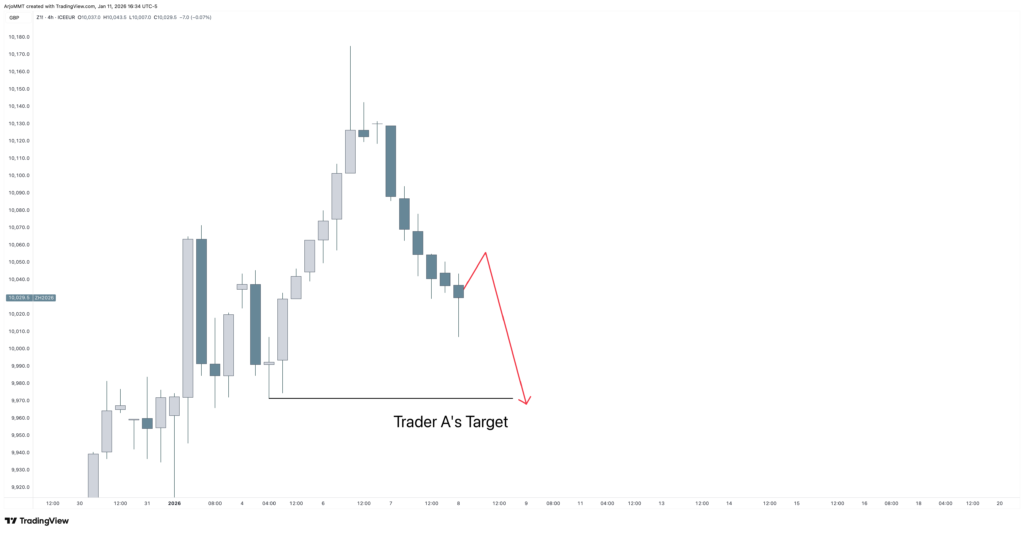
– Trader A
This trader does their analysis and comes to the conclusion that the market should reach for this next swing low.
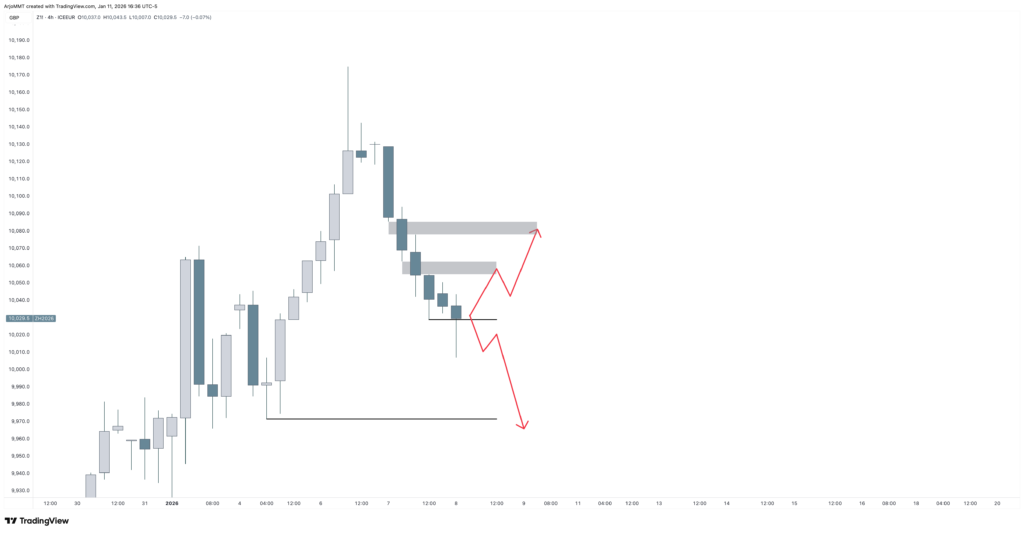
– Trader B
This trader sets parameters. If we keep disrespecting the Bearish FVG, we can reach the next Bearish FVG.
But if we run the swing low, we can reach for the next swing low.
Result
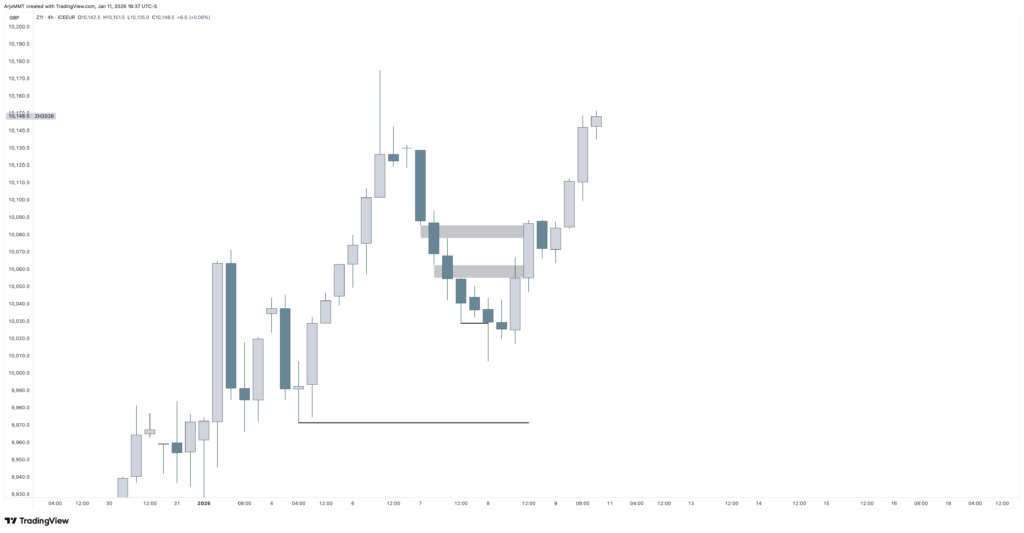
There’s a good argument to be made that Trader A is already overtrading and doing things they shouldn’t. Angry because the market didn’t agree with the analysis, and now it’s trying to force shorts.
This is also the downfall of advanced concepts, because you might end up like Trader A. You think you understand the market so well that your will is absolute.
I used to be exactly like that, and the end result is just getting frustrated; it has nothing to do with trading anymore.
Parameters
Trader B understands that if we do X, we expect Y, purely based on probabilities.
Letting the market show us whatever it wants to do and acting accordingly.
If you’re always prepared for everything how can you ever be surprised? You can’t, unless you haven’t taken the possibility into account.
In the market, there are 3 possibilities:
- We go up, bullish
- We go down, bearish
- We stay stagnant, consolidating
If you prepare yourself for all 3, you’ll never be caught by surprise, you’ll know exactly what to do.
That’s why we use parameters. In the MMT, we call it an Area of Opportunity.
Probabilities
In the above example, we were looking at FTSE, one of the indices.
Indices have a pre-defined bias; they’re more likely to move higher over time.
The reason why I say this is that not every Area of Opportunity and parameter has the same probabilities.
The bearish parameter, if we did run the swing low, would inherently be lower probability.
So the way you then manage your risk is important.
The possibility of consolidation would, of course, also be a lower probability of trade. I personally wouldn’t even trade it if it were consolidating.
So this creates a hierarchy for yourself:
- Bullish scenario, highest probability.
– Perfect - Bearish scenario, mid probability.
– Tighter risk management, potentially lower risk - Consolidation, lowest probability.
– Don’t trade
You’re preparing for all possible options whilst still understanding the different probabilities attached.
Right or Wrong
Doing your own forecast isn’t about being right or wrong; it’s about outlining all the possibilities and acting on the highest probability one according to your trading plan.
In order to do so, you do need to have some structure to your trading; the MMT can help with that.
Apply this to your trading this week and just observe, that’s step number 1, observing. Later on, once you get the hang of it, you can start trading the moves and profiting from them.
Always here if you need me.
Arjo Janssens – MMT